Editorial
Waiting on the United Nations
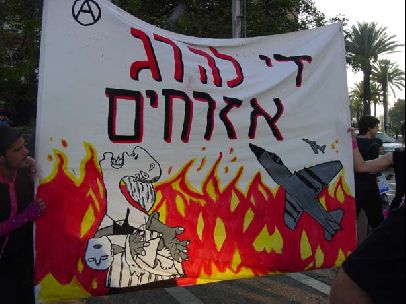
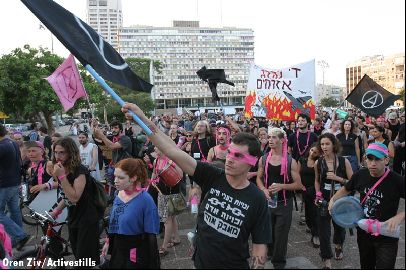
Demonstration in Tel Aviv against the war & occupation in Lebanon and Gaza on 29th July 2006.
FRIDAY AUGUST 11th - Today is the day when the UN is expected finally to pass a ceasefire resolution - reportedly it is voting in a few hours time. I was greatly heartened by hearing the British Foreign Secretary say on the News an hour ago that it would call for an "immediate" ceasefire. This is what Lebanon and Hezbollah has been asking for for now over three weeks - and Israel has refused to do.
The Israeli troops are reportedly going to have to withdraw as the Lebanese army and UN forces move in. I expect this to start to happen very quickly - at least I hope so. The Lebanese will want the Israelis out as fast as humanly possible.
I have been hearing incredible things about the debate going on between the Israeli leadership and its Generals. One government minister advocated that Israel should destroy the Lebanese electric power grid (see below) - which of course would stop water pumps, hospital equipment, and much much else. Israel did this a month ago to the Palestinians in Gaza as an act of collective punishment - so it seems some Israelis in high office think they can now do the same to the Lebanese. Reportedly many Israeli Generals are dismayed at the idea that they might be stopped before they have finished with Hezbullah. They are currently still heavily fighting within 5 miles of the border - so they have not succeeded in driving back Hezbullah despite weeks of hellishly heavy warfare.
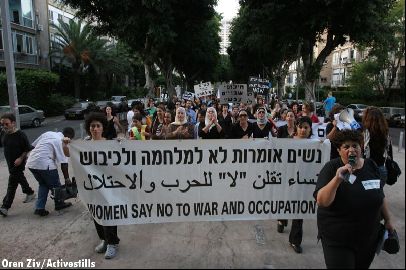
Same demonstration. (Where were the Western media cameras?) For a description of this demonstration click here
Israel is now taking it that Hezbullah has been ordered to stop - but not them. Its military says it can destroy much more of Lebanon in "defensive" military actions for another week or more - until international forces arrive.
Israeli Prime Minister Ehud Olmert responded to the resolution by promising to take it up (late) on Sunday but in the meantime to invade Lebanon with 30,000 more troops and to rush to the Litani river.
Lebanon's acting Foreign Minister Tarek Mitri expressed profound doubts about the likelihood of the resolution being able to end the war and was scathing in his criticism of Israel. "For a month now, as the world continues to watch and the international community continues to watch, Israel has besieged and ravaged Lebanon, creating a humanitarian and environmental disaster," he said.
Mitri characterised the weeks of Israeli artillery and aerial bombardments against his country as a "strategy of terror" and a "obscenely disproportionate and unjustifiable" retaliation for Hezbollah rocket attacks on northern Israel.
"The Lebanese are not confident in Israeli distinction between 'defensive' and 'offensive'," he added. "The end to military operations should be unqualified." More than 1,100 people have been killed in Lebanon and more than 900,000 displaced while Israel's bombardments have laid waste to the only international airport, roads, bridges and power stations and effectively cut the country off from the outside world.
Israel's ambassador Dan Gillerman laid the blame for the conflict with Lebanon and said the issue would return to the United Nations if Lebanon failed to implement its side of the proposed ceasefire. In other words, if Hezbullah attacks the Israeli invading forces!
Israel has lost 38 civilians and 82 soldiers. Lebanon over 1,100 civilians.
As Informed Comment reported: "Olmert also decided to destroy the power plant providing electricity to the city of Tyre, depriving ordinary people of potable water, medical care, the ability to preserve food from spoiling. This move at this point in the conflict seems especially petty. Since the reports are that Hizbullah safe houses and caves have their own power generators, it is hard to see how hitting this plant helps the Israeli war effort, and I think it is a war crime."
"The Israeli officer corps is apparently furious that the UN is now calling for a ceasefire of sorts, before they could accomplish their military goals. Gee, that is the problem with ceasefires, isn't it? Get in the way of further warmaking, if you pay attention to them."
"The Israeli public, especially in the north where they have been taking daily rocket fire, is on the other hand rather less gung ho now. Approval among the public for how Olmert is handling the war has plummeted from 80 percent early on to 48 percent in a recent poll. Some 40 percent of Israelis disapprove of the war now. While hawks are saying that if he stops now, he is finished politically, the trend line of the polling suggests the opposite. If he doesn't find a way to stop the war soon, it looks as though his support will go on down to zero."
The Globe and Mail describes some other Israeli activities on the eve of "peace." "Israeli warplanes bombed southern Beirut and the south of the country again in the 31st day of violence. In the far north, one of the last remaining bridges to Syria was destroyed in a strike that killed at least 12 people;
In the south, heavy fighting continued around the Christian town of Marjayoun, a key point overlooking the Litani River for Israeli artillery positions. Aid agencies tried again in vain to get supplies to cut-off towns south of the Litani River, and the mayor of Tyre warned the city would run out of food in two days.
A convoy of hundreds of civilians and about 350 Lebanese soldiers and police, escorted by UN peacekeepers out of Marjayoun, was hit by several Israeli missiles when part of the convoy detoured from the approved route, apparently to avoid traffic jams. At least four people were reported killed and 40 others wounded. That's right. The Israelis bombed a civilian convoy attempting to obey their instructions, the departure of which had been coordinated with them through UNIFIL.
'In one of the most dramatic development in the fighting Friday, an Israeli unmanned plane fired at the convoy, which included a 350 joint Lebanese army and police force as well as 500 civilian cars. They left Marjayoun after hours of U.N. mediated negotiations which succeeding in receiving Israeli assurances for the convoy's safety.'
The attack came as the convoy was en route from Jib Jannin to Kefraya in the south of the Bekaa valley, security officials said. They said most of the casualties were civilians. "The Israeli forces had been told in advance of the convoy's passage, and had given it the green light," UNIFIL spokesman Milos Strugar said. '
It seems the Israeli military are either utterly disorganised, or, more likely, letting vengeance and anger override all common human decency.
The idiotic terrible score right now.
Lebanese Civilians killed - over 1000 ( many are not yet dug out of ruins) . Israeli civilians killed - 36.
Soldiers killed - Israeli about 75 - Hezbollah thus kills mostly the military. Hezbollah soldiers killed - Israel claims about 200. Hezbollah admits to few. I will update these figures.
Yesterday Israel sent in one morning session over a thousand shells into just one Lebanese town. Each shell has more explosive force than the average Hezbollah rocket. Israel uses over 5000 shells, bombs and rockets a day. Hezbollah is estimated to have fired 3500 rockets total -i n four weeks.
I just hope and pray that this is about to come to an end.
And - when it does. Then is the time for legal justice. Keep on sending in your letters. Let our legal system sort out which party violated international law most blantently and often.
As for this website - it will develop as we look into the fundamental issues and possible solutions.
Janine Roberts 11th Aug 2006
post script - the information below appeared in Haaretz, a major Israeli newspaper today. It helps to explain some of the attitudes and opinions within the Israeli cabinet and military that influence Israeli decisions right now. My comments are in italics.
IDF General Staff fiercely opposed to cease-fire terms
"One dispute that delayed the agreement was over Shaba Farms. Prime Minister Ehud Olmert rejected a Lebanese-French demand that Israel withdraw from this area and transfer it to an international force until the UN, which had previously ruled Shaba part of Syria, decides how to handle Lebanon's claim. The new draft merely states that the dispute over Lebanon's borders, including around Shaba Farms, must be resolved, and instructs UN Secretary General Kofi Annan to propose a plan for doing to. "
Comment - this is a dangerous. The issue needs urgent settlement Most clashes between Hezbullah and Israeli armed forces over the past 5 years have been over the Shaba Farms. If the issue is left unsettled, then it may in the future cause more fighting.
"Government sources expressed satisfaction with the new draft, saying that it includes two key Israeli demands: an international force with teeth, and the disarmament of south Lebanon below the Litani River. "It's true that the problem of Hezbollah has not been solved," admitted one, "but we are also not in a position to solve it militarily."
A rare concession by an Israeli spokesman. But I would not call moving 30,000 troops into South Lebanon (half members of the Lebanese army) the disarming of this region. Hezbollah forces will still be within 20 miles of the border. What happens if Hezbollah soldiers, and trainers, join the Lebanese army? It is likely eventually to happen. But - I do not predict further war. I think after a while the international forces will go or be minimalised. After all , this border has been quiet (except at the Farms) for most of the past six years. I am hoping that this will now mean that Israel will no longer be able to over fly Lebanese territory with impunity - as they have done for over 20 years.
However, the Defense Ministry and the IDF General Staff are fiercely opposed to the emerging cease-fire, and senior defense officials accused Olmert of blocking the proposed advance to the Litani, thereby denying Israel a significant military achievement.
that is the trouble for Israeli military. In their eyes, they have not won a "significant military achievement" . Perhaps Israel will have to learn that its security lies best in having good relations with neighbours, and treating Palestinian refugees with justice.
The officials charged that the emerging resolution is very problematic for Israel, because it makes no provision for the immediate return of the kidnapped soldiers (it urges their return, but this is not one of the resolution's operative clauses), includes no stringent supervisory mechanism to prevent a renewed flow of arms to Hezbollah, and does not guarantee the organization's disarmament. "[Hezbollah leader Hassan] Nasrallah will continue to mock us, and in the end there will be another war," said one. "We understand that the leadership wants to do everything possible to save soldiers' lives, but too much is in the balance here," added another. "We must continue."
The defense officials argued that the cabinet should have allowed the expanded operation approved on Wednesday to start immediately, thereby creating military pressure for a cease-fire more favorable to Israel. By delaying the operation, they said, this opportunity has apparently been missed.
The terms of the resolution were agreed upon following talks between the five permanent members of the Security Council - U.K., France, U.S., Russia, and China. The deal was coordinated with Israel and apparently with the Lebanese government. In his efforts to advance the cease-fire, U.S. Assistant Secretary of State David Welch departed Beirut on Thursday and arrived in Israel, where he updated Foreign Minister Tzipi Livni on the latest diplomatic developments.
The resolution will stop short of requiring peacekeepers to disarm Hezbollah but will call for an embargo to prevent the group from bringing in arms from Iran and Syria, a senior Israeli official said on Thursday.The official, who spoke on condition of anonymity, said the resolution would also call for creation of "an emboldened UNIFIL", the UN force currently in Lebanon and long derided by Israel as ineffective.
But the official said: "The (international) force will not have any mandate to disarm Hezbollah."The official added that the resolution would also include "an embargo that will prevent the supply of arms to Lebanon that are not for the Lebanese army."
The revised draft calls for a "progressive" Israeli withdrawal, a senior Lebanese political source said on Thursday."The Americans have moved their position. A deal with the French is very close in the next hours, but most likely on Friday," he told Reuters. " The breakthrough is based on the inclusion in the call for a cessation of hostilities for a progressive Israeli withdrawal from Lebanese territory to go simultaneously with the deployment of the Lebanese army backed by reinforced UN peacekeepers." The source said the peacekeepers would mainly be reinforced by French soldiers. As part of the deal, Hezbollah would pull out from south of the Litani river.
Officials in Jerusalem were hopeful the new resolution would be based on Chapter Seven of the UN Charter rather than Chapter Six, which was referenced as the foundation of an earlier U.S.-French cease-fire resolution. A resolution which invokes Chapter Seven would empower an international contingent of troops in Lebanon to apply force and level sanctions against any party which violates the terms of the cease-fire.
I think they have not got Chapter 7
As such, there would be no need in formulating an additional Security Council resolution which would detail the force's mandate. In recent weeks, a number of countries announced they would agree to contribute soldiers to any multi-national force deployed in Lebanon.
Peretz vows to exhaust all diplomatic options
Defense Minister Amir Peretz stated Thursday that Israel will exhaust diplomatic options before expanding the military operation in Lebanon."We are responsible for considering all options," Peretz said while visiting the northern border, accompanied by Israel Defense Forces Chief of Staff Dan Halutz and GOC Northern Command Udi Adam. "The minute troops set out to accomplish a mission, we must look in the eyes of every mother, every father and every child and say: We exhausted all other options," Peretz said.
Peretz said an integrated effort between the diplomatic and military plains was being made.He presented four conditions set by Israel for an end to the fighting: The demilitarization of southern Lebanon, the deployment of a multi-national force in southern Lebanon, a real commitment to disarm Hezbollah setting an outline for a plan to return the abducted IDF soldiers and removing the Katyusha rocket threat.
"We plan to free residents of northern Israel from the bomb shelters," Peretz said. His remarks were cut short when a rocket alarm siren went off, and his body guards rushed him to a nearby bomb shelter.
Earlier Thursday, the defense minister also said that if a cease-fire is reached to end the month-long conflict between Israel and Hezbollah, it would have been the success of the IDF operation. "We'll see the military operation as having created the diplomatic climate and a new situation," he said.
If diplomacy fails, Peretz said, Israel will "use all of the tools" to win the war against Hezbollah. The security cabinet Wednesday gave approval in principle to the defense establishment's plan for an expanded ground operation, but delayed its implementation in order to give a chance to the UN Security Council's bid to end the crisis.
The operation, proposed by Peretz, is intended to "significantly reduce" Hezbollah rocket fire into Israel, destroy Hezbollah's infrastructure in south Lebanon and kill as many Hezbollah operatives as possible. It calls for a few Israel Defense Forces divisions to operate throughout the area south of the Litani River. The operation would last a month, the ministers were told. But according to another estimate, it will take double that time.
The cabinet resolved that the plan's implementation would depend on diplomatic developments. "There is a certain diplomatic process under way," Tourism Minister Yitzhak Herzog told Army Radio on Thursday morning. "We can allow a little more time to see if there's a possibility for a diplomatic process."
But Herzog made clear Israel would go ahead with its military plans if the talks failed. "If there won't be a diplomatic solution, there will be a need to remove this threat," he added, referring to more than 3,300 rockets Hezbollah has rained on northern Israel since July 12.
Halutz suggested destroying civilian infrastructure in Lebanon, such as the power grid. But Peretz interrupted him - "that's not in the plan I submitted to the cabinet" - and the issue was removed from the agenda.
The cabinet authorized Olmert and Peretz to decide when to launch the operation. Government sources said that no "deadline" had been set, but the diplomatic effort would be given from "a few hours to a few days."
The six-hour cabinet meeting was tense and punctuated with arguments among the ministers. Everyone understood that an extensive ground operation would involve many fatalities and could set Israel at odds with the international community.
A particularly loud argument erupted between Peretz and former defense minister Shaul Mofaz. "If you had brought the plan on Sunday, I'd have supported it," Mofaz said. "But when I asked on Saturday whether we intend to reach the Litani, the defense minister said no. Now it's late. We don't have two months to complete the operation, and I think it will take longer."
Mofaz suggested simply capturing the Litani. "You can get there in 48 hours and say we won, and south Lebanon is surrounded. If you want, clean the area from south to north," he said.
Peretz interrupted: "Why didn't you do anything when you were chief of staff and defense minister? Where were you when Hezbollah created this deployment?"
Most of the ministers supported Mofaz's proposal, including Benjamin Ben-Eliezer and Rafi Eitan. Avi Dichter supported Peretz's proposal. But Olmert did not bring Mofaz's proposal to a vote, saying the cabinet should accept the defense establishment's proposal.
Nine ministers supported this proposal: Olmert, Peretz, Livni, Haim Ramon, Abraham Hirschson, Mofaz, Dichter, Ben-Eliezer and Eitan. Three abstained: Shimon Peres, Ophir Pines-Paz and Eli Yishai. Peres said that he did not support the move because it has already forfeited the element of surprise, may involve numerous fatalities and would endanger Israel's relations with Arab and Muslim states.
end of Haaretz piece
One should bear in mind that Israel has a history of defying UN Resolutions - far more than any other country on earth - as the following article shows.
What about Israel’s Defiance of UN Resolutions
By: Dr. Steven Harris
In what is becoming a depressingly familiar pattern, the Israeli ‘Defence Forces’ have invaded Lebanon and are causing death and destruction by land, sea and air. What was astonishing to neutral observers was Israeli spokesmen talking about the need for Lebanon to observe UN Security Council Resolution 1559 passed in 2004. This called for a number of steps to happen for Lebanon – which included the call for militias to be disbanded. This Resolution was passed by 9 votes in favour and 6 abstentions – and those who chose to abstain included Russia and China.
The Israelis were displaying their usual ‘chutzpah’ – a Jewish word roughly translated as audacity or effrontery. Israel has the dubious distinction of having had more negative UN Security Council Resolutions passed against it than any other member state. At last count the number was 66 and if the U.S. had not exercised its veto to save Israel the embarrassment of having yet another Resolution to ignore, the number would be 95! In fact, every U.S. veto used since 1986 in the Security Council was to protect Israel.
Israel owes its existence ultimately to a United Nations vote in 1947 and so it is surely ungrateful to ignore all the Resolutions directed at it from that same body.
The first Resolutions to be ignored dealt with an issue which is still one of main sticking points for any future peace in the Middle East; namely the right of Palestinian refugees to return home – UN General Assembly Resolution 194. This stated:
"Resolves that the refugees wishing to return to their homes and live at peace with their neighbors should be permitted to do so at the earliest practicable date, and that compensation should be paid for the property of those choosing not to return and for loss of or damage to property which, under principles of international law or in equity, should be made good by the Governments or authorities responsible."
There then followed the by now famous and most pointedly ignored; Security Council Resolution 242, passed on 22 November 1967 that calls for the withdrawal of Israeli forces from territories occupied in the war that year and;
"The acknowledgment of the sovereignty, territorial integrity and political independence of every state in the area and their right to live in peace within secure and recognized boundaries free from threats or acts of force."
There then followed one in 1979 regarding Israel’s colonial settlements; Security Council Resolution 446, March 22, 1979
"Determines that the policy and practices of Israel in establishing settlements in the Palestinian and other Arab territories occupied since 1967 have no legal validity and constitute a serious obstruction to achieving a comprehensive, just and lasting peace in the Middle East."
In the light of the Resolutions listed below, it might not be a good idea for Israel to remind the world of the need to enforce UN Resolutions. The UN has also suffered directly at the hands of Israel. The recent shelling and death of 4 unarmed UN observers in Lebanon may have been a genuine accident but given Israel’s track record with the UN, even the reticent Kofi Annan was forced to say that the shelling was ‘apparently deliberate’. The US threatened to veto any Resolution condemning Israel. Israel’s contempt and hatred for the UN goes back to its inception. Back in 1948, the UN sent a Special Representative, Count Folke Bernadotte to Palestine/Israel to report on the growing disquiet of Jewish settlers killing and terrorizing the Palestinian population.
On September 17, 1948, four men dressed in Israeli Army uniforms murdered Count Bernadotte. The four killers were never brought to justice.
Israel's founding Prime Minister, David Ben-Gurion, knew who the assassins were: members of the so-called Stern Gang, a Jewish terrorist group of several hundred members founded in 1940. The man who organized the killing of Count Bernadotte was Yitzhak Shamir, who later became Prime Minister of Israel in 1983. The other Israeli terrorist organization operating at the time was Irgun. Many of its leaders were later honoured by the state of Israel and the current Foreign Minister of Israel, Tzipi Livni is the daughter of a prominent Irgun member, Eitan Livni, who was sentenced to 15 years in jail by the British for terrorism.
In meanwhile, as Israel continues to defy worldwide opinion of its activities in relation to its neighbours and most importantly towards the Palestinians; it can rest assured that having ignored so many UN Resolutions in the past, in the unlikely event it is called on to withdraw yet again from Lebanon, it can ignore the call without any threat of sanctions.
The Islamic world can hardly fail to be outraged by the double standards regarding the definition of terrorism and selective memory regarding UN Sanctions. Given the increasingly blatant misuse of the UN, it may not be long before the UN goes the same way as the League of Nations set up between the 2 World Wars but failed to prevent any war, aggression or even to punish. Sound familiar?
1. Resolution 106: The Palestine Question (29 Mar 1955) 'condemns' Israel for Gaza raid.
2. Resolution 107: The Palestine Question (30 Mar)
3. Resolution 108: The Palestine Question (8 Sep)
4. Resolution 111: " . . . 'condemns' Israel for raid on Syria that killed fifty-six people".
5. Resolution 127: " . . . 'recommends' Israel suspends it's 'no-man's zone' in Jerusalem".
6. Resolution 162: " . . . 'urges' Israel to comply with UN decisions".
7. Resolution 171: " . . . determines flagrant violations' by Israel in its attack on Syria".
8. Resolution 228: " . . . 'censures' Israel for its attack on Samu in the West Bank, then under Jordanian control".
9. Resolution 237: " . . . 'urges' Israel to allow return of new 1967 Palestinian refugees".
10. Resolution 242 (November 22, 1967): Termination of all claims or states of belligerency and respect for and acknowledgement of the sovereignty, territorial integrity and political independence of every State in the area. Calls upon Israel to withdraw its forces from land claimed by other parties in 1967 war. Interpreted commonly today as calling for the Land for peace principle as a way to resolve Arab-Israeli conflict.
11. Resolution 248: " . . . 'condemns' Israel for its massive attack on Karameh in Jordan".
12. Resolution 250: " . . . 'calls' on Israel to refrain from holding military parade in Jerusalem".
13. Resolution 251: " . . . 'deeply deplores' Israeli military parade in Jerusalem in defiance of Resolution 250".
14. Resolution 252: " . . . 'declares invalid' Israel's acts to unify Jerusalem as Jewish capital".
15. Resolution 256: " . . . 'condemns' Israeli raids on Jordan as 'flagrant violation".
16. Resolution 259: " . . . 'deplores' Israel's refusal to accept UN mission to probe occupation".
17. Resolution 262: " . . . 'condemns' Israel for attack on Beirut airport".
18. Resolution 265: " . . . 'condemns' Israel for air attacks for Salt in Jordan".
19. Resolution 267: " . . . 'censures' Israel for administrative acts to change the status of Jerusalem".
20. Resolution 270: " . . . 'condemns' Israel for air attacks on villages in southern Lebanon".
21. Resolution 271: " . . . 'condemns' Israel's failure to obey UN resolutions on Jerusalem".
22. Resolution 279: " . . . 'demands' withdrawal of Israeli forces from Lebanon".
23. Resolution 280: " . . . 'condemns' Israeli attacks against Lebanon".
24. Resolution 285: " . . . 'demands' immediate Israeli withdrawal form Lebanon".
25. Resolution 298: " . . . 'deplores' Israel's changing of the status of Jerusalem".
26. Resolution 313: " . . . 'demands' that Israel stop attacks against Lebanon".
27. Resolution 316: " . . . 'condemns' Israel for repeated attacks on Lebanon".
28. Resolution 317: " . . . 'deplores' Israel's refusal to release Arabs abducted in Lebanon".
29. Resolution 332: " . . . 'condemns' Israel's repeated attacks against Lebanon".
30. Resolution 337: " . . . 'condemns' Israel for violating Lebanon's sovereignty".
31. Resolution 338 (October 22, 1973): cease fire in Yom Kippur War
32. Resolution 339 (October 23, 1973): Confirms Res. 338, dispatch UN observers.
33. Resolution 347: " . . . 'condemns' Israeli attacks on Lebanon".
34. Resolution 425 (1978): 'calls' on Israel to withdraw its forces from Lebanon". Israel's withdrawal from Lebanon was completed as of June 16, 2000.
35. Resolution 350 (31 May 1974) established the United Nations Disengagement Observer Force, to monitor the ceasefire between Israel and Syria in the wake of the Yom Kippur War.
36. Resolution 427: " . . . 'calls' on Israel to complete its withdrawal from Lebanon.
37. Resolution 444: " . . . 'deplores' Israel's lack of cooperation with UN peacekeeping forces".
38. Resolution 446 (1979): 'determines' that Israeli settlements are a 'serious obstruction' to peace and calls on Israel to abide by the Fourth Geneva Convention".. Israeli settlements in the occupied territories thus declared illegal.
39. Resolution 450: " . . . 'calls' on Israel to stop attacking Lebanon".
40. Resolution 452: " . . . 'calls' on Israel to cease building settlements in occupied territories".
41. Resolution 465: " . . . 'deplores' Israel's settlements and asks all member states not to assist Israel's settlements program".
42. Resolution 467: " . . . 'strongly deplores' Israel's military intervention in Lebanon".
43. Resolution 468: " . . . 'calls' on Israel to rescind illegal expulsions of two Palestinian mayors and a judge and to facilitate their return".
44. Resolution 469: " . . . 'strongly deplores' Israel's failure to observe the council's order not to deport Palestinians".
45. Resolution 471: " . . . 'expresses deep concern' at Israel's failure to abide by the Fourth Geneva Convention".
46. Resolution 476: " . . . 'reiterates' that Israel's claim to Jerusalem are 'null and void'".
47. Resolution 478 (August 20, 1980): 'censures (Israel) in the strongest terms' for its claim to Jerusalem in its 'Basic Law'.
48. Resolution 484: " . . . 'declares it imperative' that Israel re-admit two deported Palestinian mayors".
49. Resolution 487: " . . . 'strongly condemns' Israel for its attack on Iraq's nuclear facility".
50. Resolution 497 (17 December 1981) decides that Israel's annexation of Syria's Golan Heights is 'null and void' and demands that Israel rescinds its decision forthwith.
51. Resolution 498: " . . . 'calls' on Israel to withdraw from Lebanon".
52. Resolution 501: " . . . 'calls' on Israel to stop attacks against Lebanon and withdraw its troops".
53. Resolution 509: " . . . 'demands' that Israel withdraw its forces forthwith and unconditionally from Lebanon".
54. Resolution 515: " . . . 'demands' that Israel lift its siege of Beirut and allow food supplies to be brought in".
55. Resolution 517: " . . . 'censures' Israel for failing to obey UN resolutions and demands that Israel withdraw its forces from Lebanon".
56. Resolution 518: " . . . 'demands' that Israel cooperate fully with UN forces in Lebanon".
57. Resolution 520: " . . . 'condemns' Israel's attack into West Beirut".
58. Resolution 573: " . . . 'condemns' Israel 'vigorously' for bombing Tunisia in attack on PLO headquarters.
59. Resolution 587: " . . . 'takes note' of previous calls on Israel to withdraw its forces from Lebanon and urges all parties to withdraw".
60. Resolution 592: " . . . 'strongly deplores' the killing of Palestinian students at Bir Zeit University by Israeli troops".
61. Resolution 605: " . . . 'strongly deplores' Israel's policies and practices denying the human rights of Palestinians.
62. Resolution 607: " . . . 'calls' on Israel not to deport Palestinians and strongly requests it to abide by the Fourth Geneva Convention.
63. Resolution 608: " . . . 'deeply regrets' that Israel has defied the United Nations and deported Palestinian civilians".
64. Resolution 636: " . . . 'deeply regrets' Israeli deportation of Palestinian civilians.
65. Resolution 641: " . . . 'deplores' Israel's continuing deportation of Palestinians.
66. Resolution 672: " . . . 'condemns' Israel for violence against Palestinians at the Haram al-Sharif/Temple Mount.
67. Resolution 673: " . . . 'deplores' Israel's refusal to cooperate with the United Nations.
68. Resolution 681: " . . . 'deplores' Israel's resumption of the deportation of Palestinians.
69. Resolution 694: " . . . 'deplores' Israel's deportation of Palestinians and calls on it to ensure their safe and immediate return.
70. Resolution 726: " . . . 'strongly condemns' Israel's deportation of Palestinians.
71. Resolution 799: ". . . 'strongly condemns' Israel's deportation of 413 Palestinians and calls for their immediate return.
end.